
Not every channel switch means something has gone wrong
A customer starts on your web chat. Ten minutes later, they’re on the phone. Has something gone wrong?
Maybe not. They might have realised their issue is easier to talk through with a person, or chat simply wasn’t getting them anywhere. From the outside, both look the same. For the customer, they feel completely different.
We believe communication should be simple. Customers deserve to ask a question or raise a problem without effort, and a few things make that possible. First is understanding why customers switch channels, because they do it all the time.
Gartner’s survey of 1,492 customers found that 88% of journeys starting in self-service end up touching more than one channel.
That’s the real problem. It isn’t that customers switch channels. It’s that every switch can increase effort and cost your business time and money when the conversation doesn’t travel with them.
Why customers switch channels
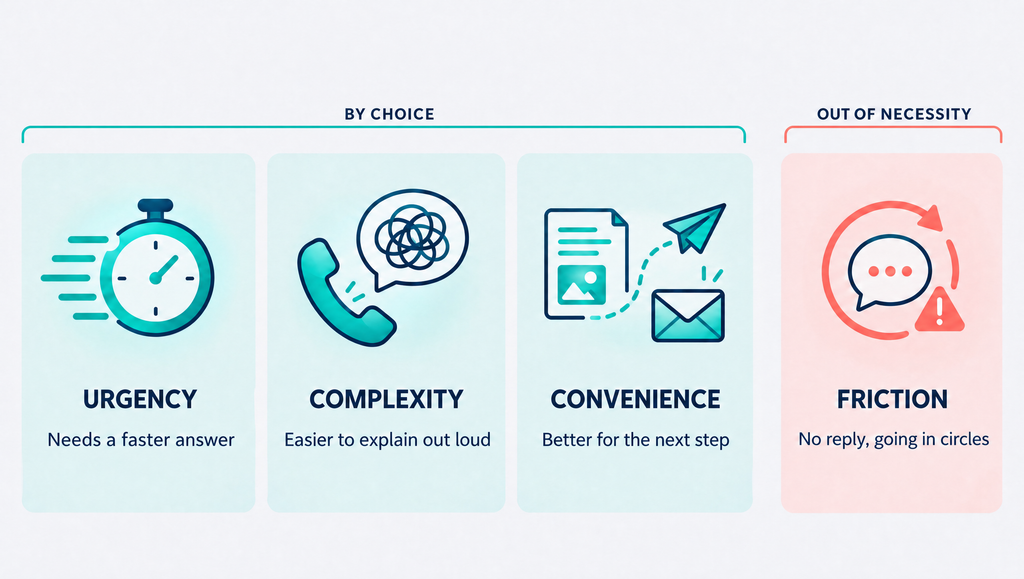
Some switches are a choice. Customers move because the issue is urgent and they want a faster response, because it’s complex and easier to explain out loud, or because another channel is simply more convenient for the next step, like moving from WhatsApp to email to send a document.
Why switching creates friction
Then there’s the switch nobody chooses: friction. No reply, going in circles, an issue that never seems to get resolved. The customer isn’t picking a better channel. They’re escaping a bad one.
Knowing how to improve customer service starts with spotting this friction. A customer who has to chase or start over hasn’t been served well, however good each channel looks.
What businesses can do: what each switch is telling you
So how do you fix it? It starts with why customers switch channels. Here’s how to manage customer enquiries across multiple channels, reason by reason:
| Reason | What to do |
|---|---|
| Urgency | Make urgent enquiries easy to escalate and set clear expectations on response times. |
| Complexity | Make sure the person taking over has the context and knows what’s already been tried. |
| Convenience | Let customers share what’s needed without losing track of the original issue. |
| Friction | Treat repeat contact across channels as a warning, and check whether the issue is unresolved, the reply fell short, or no one owned it. |
Making handoffs easier: what “simple” looks like
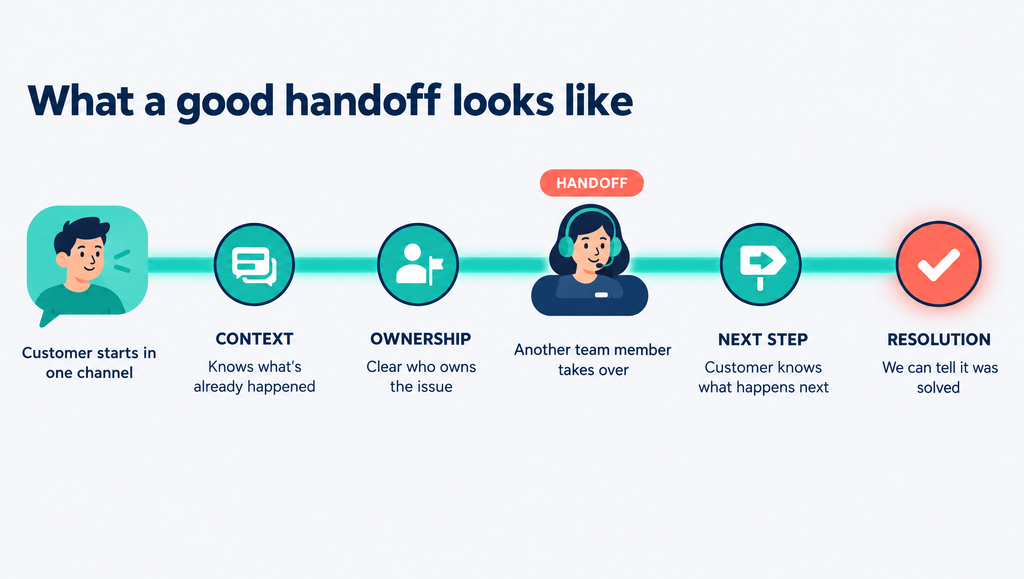
Most businesses put their energy into making each channel good, but the handoff between them is where things quietly fall apart. The same Gartner survey found 62% of these transitions are high effort for customers, while 74% of those who had an easy one said they’d use self-service again.
Here’s how to prevent customers from repeating themselves: give every transition a clear next step. So every transition needs a clear next step. For the customer, simple comes down to four questions.
- Does the next person know what’s already happened?
- Is it clear who owns the issue?
- Does the customer know what happens next?
- Can you tell whether it was actually resolved?
When all four answers are yes, customers don’t repeat themselves; they know who’s helping, and they know what’s coming.
Find out where your customer journey breaks down
It’s easy to assume your handoffs work. In Five9’s 2026 survey of 3,000 consumers and 600 CX decision-makers, nearly all decision-makers said context is preserved when AI hands over to a human, yet 83% of consumers still repeat themselves at least sometimes after a transfer.
So check, don’t assume. To see why customers switch channels in your own business, pull 10 to 20 recent enquiries that moved between channels and note:
- Where the customer started and ended up
- Why they switched
- Whether they had to repeat themselves
- Whether the issue was resolved
- Where delays or extra steps crept in
It’s not a scientific study, just a way to spot patterns. You may find response times look great on WhatsApp and the phone, yet customers still wait when moving between them. It’s also a practical way to learn how to manage customer enquiries across multiple channels: start with what’s already happening.
The goal: more time, more savings and more space
Learning how to improve customer service comes down to one goal: customers never have to repeat themselves, and your team isn’t left juggling it all. Here’s what that frees up.
- Time – Gartner’s research found seamless transitions save an average of 4 minutes of rep time per customer journey, because reps stop asking customers to repeat themselves. Across hundreds of enquiries, that adds up fast.
- Money – Less time per enquiry means a lower cost per resolution, and Gartner links seamless transitions to stronger loyalty, so fewer customers slip away.
- Space – When conversations live in one place, on an omnichannel communication platform instead of across several apps, your team has less clutter on screen and in their heads, and more room to focus on the customer.
Introducing OMNI
OMNI is ORENCloud’s omnichannel communication platform. It brings conversations from supported messaging channels, like WhatsApp, web chat, Facebook, Instagram, and email, into one place, so context stays with the conversation, and your team keeps visibility. (Voice sits within our separate telephony offerings.)
It’s built to help you put this article into practice: fewer repeated questions, less time spent chasing context, and one clear view of what’s happening across your conversations. In other words, communication that’s simple for your customers and for your team.
Ready to make every handoff simpler? Get in touch with our team and see how OMNI can fit the way your business already works.
Customers will keep moving between channels. Once you know why customers switch channels, whether it feels effortless or exhausting is up to you.
Frequently asked questions
Why customers switch channels usually comes down to four reasons: the issue is urgent, complex, or easier to handle elsewhere, or friction in the first channel pushed them out. The first three are choices. The fourth is a warning sign.
No. Moving from chat to a call because they’d rather talk it through is just a customer choosing the right tool. It becomes a problem when they switch because they weren’t getting an answer.
Pass on the context and what’s already been tried, make it clear who owns the issue, and tell the customer what happens next.
Review 10 to 20 recent enquiries that moved between channels. Note why customers switched, whether they repeated themselves, and whether the issue was resolved.