About OMNI: An omnichannel solution provider in Malaysia that connects your customer conversations (WhatsApp, web chat, Facebook, Instagram, email) in one place, so your team sees the whole story and customers stop repeating themselves. You probably need one if customers re-explain things, agents juggle tabs, or every new channel adds another inbox. We provide for business in Malaysia, Singapore, Thailand and Indonesia.
In short: the problem is customer conversations scattered across too many apps. The fix is one connected inbox with routing, reporting and an easy hand-off to a person. The goal is to win back time, money and space to grow.

Friday, 11:52 p.m. Aisha sits alone in a dark office with a cold cup of tea, 214 unread messages and a half-written email titled “Resignation.” Her cursor hovers over Send.
She loves this job. So how did she get here in five days? Let’s rewind to Monday.
Meet Aisha. She runs customer service at Cozy Corner, an online homeware shop in Malaysia that sells everything from rice cookers to one suspiciously popular cushion cover. (Aisha is fictional. Her problems are not.) Business is booming, and most of it arrives through WhatsApp. Her sanity, however, is another matter.
Eleven days until the 11.11 sale, and Daniel, her boss, has bet the whole quarter on it. He has big plans and a worrying love of the phrase “quick question.” Then there’s Hafiz, her loyal chat agent, who answers every message as if it’s the first of the day. And there’s Aisha, the one person who knows how it all really works. Over five signs, we’ll follow one very long week in her life, and you may spot your own.
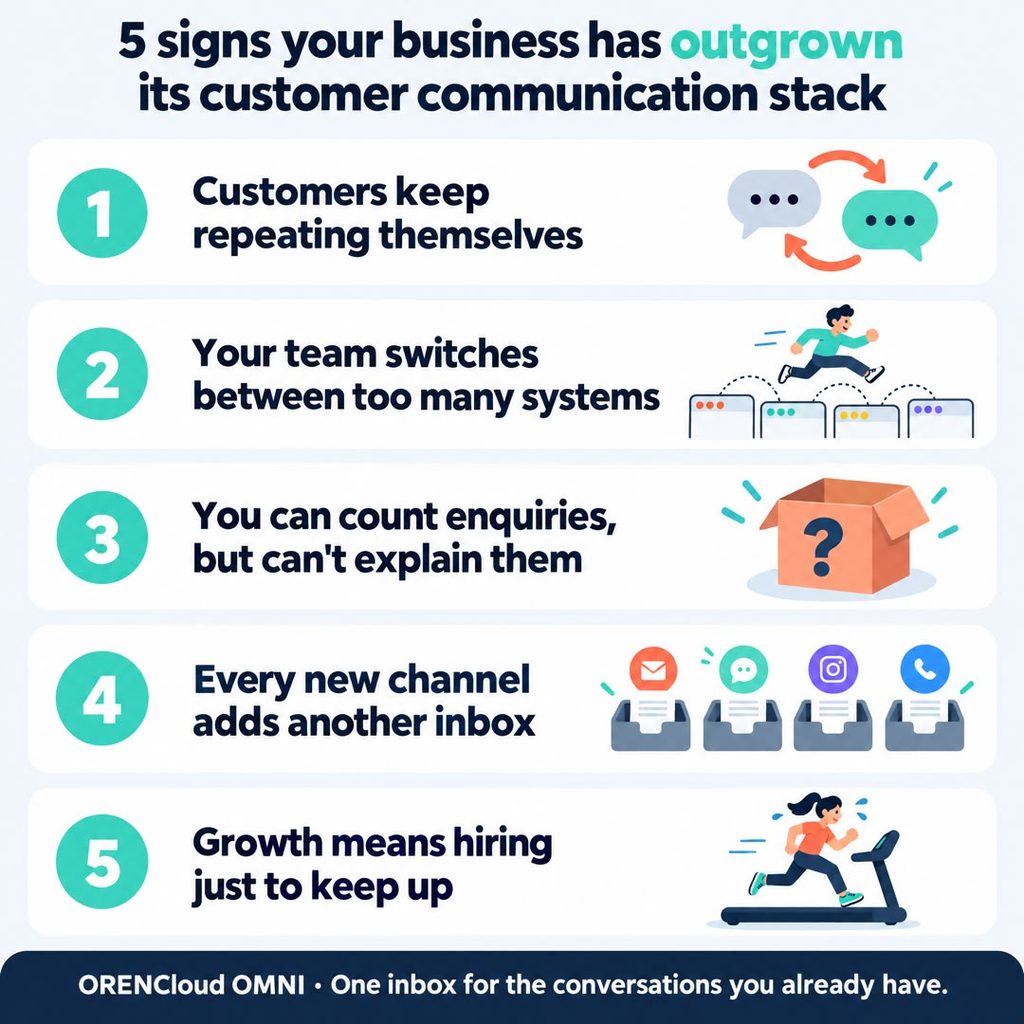
1. Customers keep repeating themselves
On Monday morning, Mr. Lim messages Cozy Corner on WhatsApp about a kettle that never arrived. Silence. By lunchtime, he’s emailing, and Hafiz replies warmly, asking him to start from the top. Mr. Lim’s answer lands like a slap: “This is the third time I’m explaining this.” Aisha reads it over Hafiz’s shoulder, and her stomach drops. She knows that tone. She’s used it herself, on other companies, at 11 p.m., with a cold dinner beside her.
She’s far from alone: Zendesk’s CX Trends 2026 research found 74% of consumers get frustrated when they have to repeat information. Mr. Lim didn’t want a sequel. He wanted a conversation. Aisha checks the calendar. It’s only Monday.
Quick test: message your own business on one channel, then another. Does anyone remember you?
2. Your team switches between too many systems
On Tuesday, finding Mr. Lim’s kettle takes Hafiz eleven minutes. Eleven. He hops from WhatsApp Web to email, then the CRM, then the same spreadsheet they have been using for years, then Instagram, with a customer waiting at every stop. The team calls this the Tab Olympics, and nobody is winning.
That evening, Aisha learns she isn’t imagining it: ServiceNow’s Singapore survey found reps use more than four systems per case, leaving just 35% of their time for the customer’s actual issue. Hafiz, who once closed the wrong tab and lost half a conversation, takes it personally. It’s past seven, and he’s still at his desk, apologising to a spreadsheet. “I’m trying, Kak Aisha.” She knows he is. That’s what hurts.
Quick math: You lose roughly 1.5 minutes per enquiry, at 30 enquiries per agent per day, with 10 agents over 240 working days, and that’s 1,800 hours a year: almost one full-time person, paid to hop between windows.
Quick test: sit beside an agent for an hour and count the windows. (Bring snacks.)
3. You can count enquiries but can’t explain them
On Wednesday, Daniel calls a meeting. He has just skimmed a McKinsey report on a flight, which makes him dangerous. “Why are we getting so many messages?” he asks. Every head in the room turns to Aisha. “Delivery,” she says. A pause. “Probably.” Daniel’s eyebrow rises, slowly. She has thousands of messages, five apps and, as far as proof goes, vibes.
Daniel’s flight reading, at least, had a point. McKinsey’s customer care research found that 42% of its top-performing teams brought rising inbound volumes back down by helping customers find answers themselves, like a clear help page or an instant reply to the question everybody asks. Its advice on where to begin: a root-cause analysis of why customers get in touch.
Aisha’s cheeks burn. Three years of running this team, and she can’t answer the simplest question in the room. You can’t write a help page for “delivery, probably.” To head questions off, you first need to know which ones keep coming, and hers are scattered across five apps, each holding one piece of the answer. Her messages weren’t a mystery. They were just in five different boxes. It’s only Wednesday.
Quick test: can you name last month’s top five contact reasons without losing a weekend to spreadsheets?
4. Every new channel adds another inbox
On Thursday, Hafiz finds an Instagram message asking whether the cushion cover comes in green. Sent Monday. Right under it, sent last night: “Never mind, I bought it somewhere else.” Nobody had opened that inbox since the weekend, and it wasn’t laziness. Cozy Corner added WhatsApp, then live chat, then Instagram, each for a perfectly good reason, but together they made five inboxes, five logins and five chances to answer the same question differently. Somewhere out there, a customer who wanted to hand over money just handed it to someone else.
Then, before Aisha can recover, Daniel announces plans to sell in the Philippines and Vietnam. She looks it up with a sinking feeling: Infobip’s May 2026 estimates put WhatsApp reach at around 90% in Malaysia and Singapore, but Messenger near 95% in the Philippines and Zalo near 85% in Vietnam. “Wonderful,” she says, smiling the way people smile when they are quietly screaming. “Two more inboxes.”
Quick test: ask the same question on three channels. Same answer? And if staff use personal WhatsApp with customers, the history leaves when they do.
5. Growth means hiring just to keep up
By Friday evening, the office has emptied out, except for Aisha, Hafiz and Daniel, who has two ideas for 11.11: hire two more people, or “just put a chatbot on it.” Aisha feels her chest sag. She is the human glue between five inboxes, and glue doesn’t scale. More customers means more messages, and if it all stays manual, headcount climbs with volume.
But swapping people for software isn’t the answer either: in a Gartner survey run in early 2026, 87% of customers said companies using generative AI must offer a way to reach a human. “They want a person, Daniel,” she says, louder than she meant to. The room goes quiet. The smarter move is automating the routine and keeping people for the conversations that matter. Nobody in that room knows how to get there yet.
Quick test: list the five questions your team answers most. How many are simple look-ups?
The problem in one line: it was never too many messages. It’s that every conversation sits in a different box, and your team is the only thing connecting them.
Which brings us back to 11:52 p.m. Aisha stares at the draft titled “Resignation.” She thinks of Mr. Lim, of the customer who bought a green cushion cover somewhere else, of Hafiz apologising to a spreadsheet. Then she closes the draft. She does not send it.
At 12:04 a.m., with cold tea and low expectations, she opens her trusty AI app and types the question she has been too tired to say out loud: “I’m drowning in chats from five different apps. How do I make this easier?” The answer arrives in seconds, calmer than she is: stop adding channels and bring the ones you already have into one inbox. Look for an omnichannel solution provider. Aisha reads it twice. What she finds next decides whether she stays, and whether Cozy Corner survives 11.11. We’ll get back to her at the end. First, here’s what she found.
How ORENCloud OMNI answers all five
ORENCloud OMNI is an omnichannel customer chat platform that brings WhatsApp, web chat, Facebook, Instagram and email messages into one inbox. Here’s how that maps to Aisha’s five problems:
| Sign | What ORENCloud Does |
|---|---|
| Customers repetition | Conversations from every channel land in one inbox, and chats can be routed to the right agent or escalated to another team. |
| Your team’s system switching | Tools like your CRM or ticketing system can open inside the OMNI screen. |
| Enquiries you can’t explain | Labels for reporting, plus dashboards for team performance, customer satisfaction and channel metrics. |
| More channels, more inboxes | Also supports channels such as Telegram and Messenger, and other platforms through webhooks. |
| Hiring just to keep up | Canned replies, plus an optional Cosine AI chatbot that answers common questions around the clock and hands over to a person. |
One honest boundary: ORENCloud OMNI covers chat and messaging. Phone calls run on ORENCloud’s separate telephony products.
OMNI can win back your time, money and space
What a team like Aisha’s really wants is freedom: from the clock, from the budget squeeze and from having no room to move. Here’s how one connected inbox gives it back.
- Time – Remember the 1,800 hours a year lost to window-hopping? With your CRM or ticketing tool opening inside the OMNI screen, canned replies for the questions everyone asks and chats routed to the right agent, your team stops searching and starts answering.
- Money – Slow replies cost sales (ask the green cushion cover), and manual work costs headcount. Faster answers, plus an optional Cosine AI chatbot that handles common questions around the clock and hands over to a person, let volume grow without your hiring plan growing at the same pace.
- Space – When conversations stop living in five places, your team can think instead of firefight. A new market becomes a question of which channels, not how many more inboxes, because OMNI also supports channels such as Telegram and Messenger, plus other platforms through webhooks. And a team with room to think moves from being the glue to being the one with the answers.
What to look for in an omnichannel solution provider
- One inbox for the channels your customers actually use (in Malaysia and Singapore, that starts with WhatsApp).
- Routing and escalation, so each conversation reaches the right person.
- Reporting by reason, not just volume.
- Automation with an easy exit to a human.
- A provider that serves your markets: We are a licensed communications provider serving businesses in Malaysia, Singapore, Thailand, and Indonesia.
Before you shortlist anyone, put these questions to every provider (us included):
Can customers reach us on WhatsApp, Instagram, Facebook, web chat and email, and will my team see them in one omnichannel inbox?
Ask for a live demo with your own channels, not a slide.
What happens when a chat needs a person?
Ask how routing, escalation, labels and canned replies work, and how a case moves from one agent to another without the customer repeating themselves.
Can I see why customers contact us, not just how many?
Look for dashboards that cover team performance, customer satisfaction and channel metrics, so you can fix the root cause instead of counting chats.
Does it open the tools my team already uses?
Check whether your CRM and ticketing system can sit inside the same screen, so nobody needs a fifth tab.
If there is a chatbot, how easily can a customer reach a human?
Automation should take the repetitive questions and hand over the rest with the full conversation attached.
What does it not cover?
A good provider will say so. (For us: OMNI is for messaging channels. Voice calls run on separate ORENCloud telephony products.)
Do you operate where my customers are?
In Malaysia and Singapore, ask whether the provider is a licensed communications provider with local presence. ORENCloud serves Malaysia, Singapore, Thailand and Indonesia, which matters if your next launch is across the border.
Daniel’s flight reading had another good tip: McKinsey advises understanding your problem before talking to any vendor. (Yes, that includes us.)
Frequently asked questions
An omnichannel solution provider supplies software that connects customer conversations across channels such as WhatsApp, web chat, social media and email in one place. The goal is continuity: whoever replies can see what’s already happened, so customers don’t have to start over.
Multichannel means you’re present on several channels that run separately. Omnichannel means those channels are connected, so a conversation can move between them without losing context.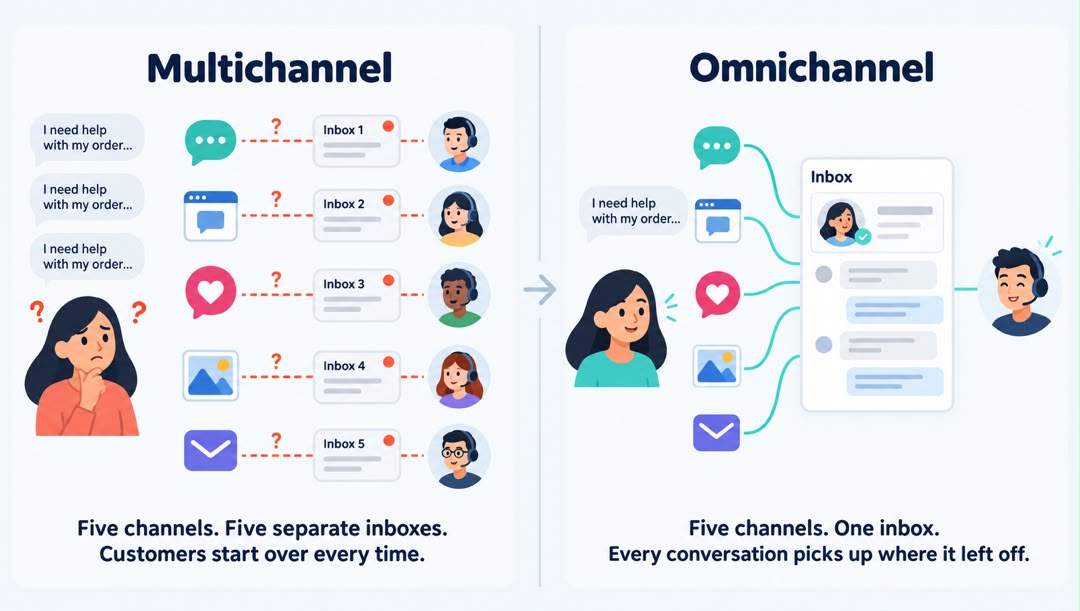
OMNI brings WhatsApp, web chat, Facebook, Instagram and email into one inbox. It also supports channels such as Telegram and Messenger, plus other platforms through webhooks.
No. OMNI covers chat and messaging channels. Voice runs on ORENCloud’s separate telephony products, including cloud telephony and its cloud contact centre.
Ready to end the Tab Olympics?
Mr. Lim, by the way, got his kettle. He even left a review and thanked Hafiz by name. On 11.11, the messages poured in like a monsoon, but Hafiz had one inbox open instead of five. A new customer asked about the green cushion cover on Instagram at 9:02 a.m. and had an answer by 9:06. And Daniel finally got his answer to “why.” It was delivery. (Aisha had been right all along. Now she had the numbers to prove it.)
That night, she ate dinner at an actual table, with hot tea. Daniel quietly dropped the plan to hire two more people. And with room to think for the first time in months, Aisha started planning the Philippines launch instead of fighting fires. The email titled “Resignation” never got sent. It’s still in her drafts, a souvenir. If that sounds like a better week, get in touch with ORENCloud and bring your list of channels.