Artificial Intelligence is rapidly transforming customer service across Malaysia, offering the promise of 24/7 support and improved operational efficiency. However, many organisations find that the impressive capabilities showcased in a product demo often fail to materialise once the system is deployed. While generic AI voice platforms can handle basic interactions, they frequently struggle with the technical and cultural nuances required for a professional Malaysian enterprise environment.
The gap between a polished demonstration and a functional, production-ready solution is significant. To succeed, businesses must move beyond flashy features and address the practical realities of multilingual communication, business-specific knowledge accuracy, and stringent local security requirements. Relying on off-the-shelf tools that lack enterprise-grade design often leads to performance bottlenecks that hinder, rather than help, the customer experience.
The Complexity of the Malaysian Linguistic Landscape
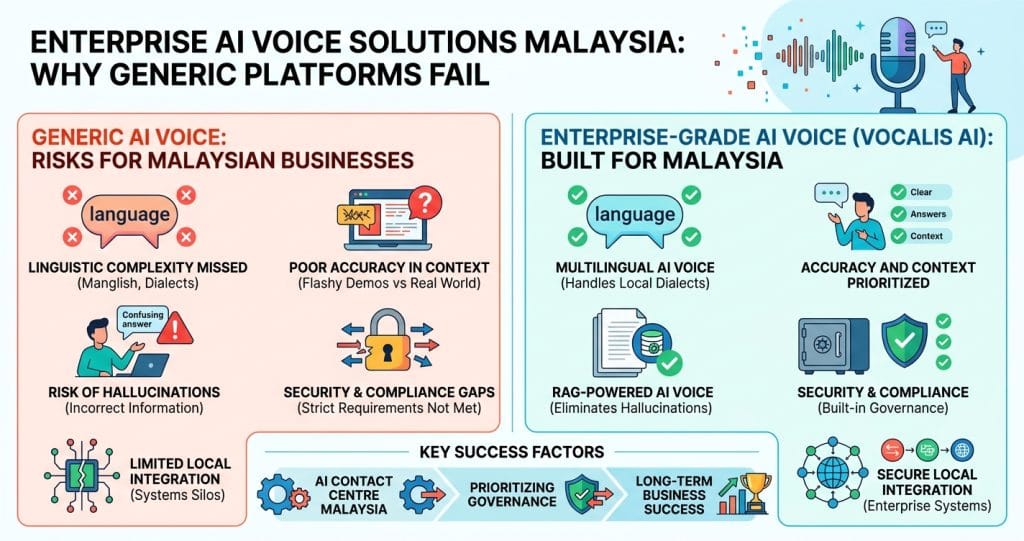
Operating a successful enterprise voice solution in Malaysia requires more than just standard language processing. The country possesses a unique linguistic fabric where communication is rarely confined to a single tongue. Customers frequently navigate between English, Bahasa Malaysia, Mandarin, Cantonese, and Tamil, often blending these languages within a single sentence. This organic code-switching is a hallmark of Malaysian daily life, yet it presents a significant barrier for generic AI platforms.
Off-the-shelf AI models are typically trained on monolithic datasets that struggle to interpret these mixed-language structures. When a system fails to recognise a phrase that shifts mid-sentence from English to Bahasa Malaysia, or misses the nuance of a colloquial Cantonese expression, the interaction breaks down immediately. Generic platforms often force users to adapt their communication style to fit the AI, which creates friction and alienates customers who expect a natural, effortless experience.
To provide high-quality support, enterprise AI must be built with a deep understanding of local speech patterns and the fluidity of our multilingual environment. Forcing a customer to choose a specific language at the start of a call ignores the reality of how Malaysians interact. Instead, effective AI must be capable of:
- Recognising and processing code-switching between major local languages seamlessly.
- Interpreting regional accents and local idioms without requiring the user to modify their tone or vocabulary.
- Maintaining context regardless of the language used to initiate or continue the query.
When an enterprise deploys technology that understands the local landscape, it removes the need for customers to second-guess how they speak. This creates a frictionless pathway to resolution, ensuring that the AI acts as a bridge for communication rather than a technical hurdle.
Why Accuracy and Context Outperform Flashy Demos
In the competitive Malaysian market, the allure of a high-tech AI demonstration often overshadows the fundamental requirement of any enterprise tool: factual reliability. While a generic platform may impress stakeholders with conversational flair and rapid-fire responses, these features are superficial if the underlying information is incorrect. For an enterprise, customer trust is built on the accuracy of product, policy, and service information. When an AI provides a customer with the wrong pricing, misinterprets a company policy, or offers outdated service details, the damage to brand reputation is immediate and difficult to reverse.
The operational costs associated with inaccurate AI responses are substantial. Every time a system fails to provide a correct answer, it necessitates human intervention to rectify the mistake, effectively negating the efficiency gains the AI was intended to deliver. Furthermore, incorrect information often leads to increased call volumes, as frustrated customers reach out to human agents to resolve the confusion created by the automated system. Over time, these errors accumulate, transforming a supposed efficiency tool into an operational liability.
To move beyond the limitations of generic platforms, enterprises must prioritize factual integrity over conversational polish. An enterprise-grade solution should focus on the following pillars of reliability:
- Knowledge Consistency: Ensuring the AI retrieves answers exclusively from verified, internal company knowledge bases.
- Contextual Awareness: Maintaining the thread of a conversation so that the AI understands specific customer queries within the scope of their unique account history.
- Operational Accountability: Providing clear pathways for escalation to human agents when the AI cannot confirm a fact with absolute certainty.
Ultimately, a successful deployment is measured not by how well the AI speaks, but by how accurately it serves the customer. Enterprises must demand systems that value precision, as reliable information is the only foundation upon which long-term customer relationships are built.
Eliminating Hallucinations with RAG Technology
For enterprises, the most significant risk associated with standard Large Language Models (LLMs) is the tendency to hallucinate. When an AI generates information that sounds convincing but is factually incorrect, it creates a liability that can damage customer trust and operational efficiency. In a professional Malaysian enterprise environment, where accuracy regarding policies, pricing, and service terms is non-negotiable, these inventions are unacceptable.
To solve this, industry leaders are adopting Retrieval-Augmented Generation (RAG) as the standard for enterprise reliability. Unlike generic models that rely solely on their internal training data, RAG restricts the AI to a verified, closed-loop knowledge base. When a customer asks a question, the system first retrieves the relevant, up-to-date information from the company’s own authenticated documents before generating a response. This process ensures that the AI acts as a reliable messenger for company data rather than an improviser.
| Feature | Standard LLM | RAG-Powered AI |
|---|---|---|
| Information Source | General training data | Verified company knowledge |
| Accuracy | Prone to hallucinations | High; restricted to facts |
| Reliability | Unpredictable | Consistent and auditable |
By implementing RAG, enterprises gain granular control over the information shared with customers. If a specific policy is not present in the verified company knowledge base, the system is designed to admit it does not have the answer rather than guessing. This level of transparency is essential for maintaining professional standards. By grounding AI interactions in verified data, organisations can confidently deploy voice solutions that provide consistent, accurate, and trustworthy support, effectively eliminating the risk of misinformation that often plagues generic, unmanaged platforms.
Security, Compliance, and Local Integration
For organisations operating in highly regulated sectors such as banking, healthcare, government, and telecommunications, security is the primary barrier to AI adoption. Generic platforms often route data through international servers, raising significant concerns regarding data sovereignty and the Malaysian Personal Data Protection Act (PDPA). Enterprises require a higher standard of governance, necessitating solutions that offer private infrastructure, controlled data access, and flexible deployment options, including on-premise setups to keep sensitive information within local borders.
Beyond security, the true value of an AI voice solution lies in its ability to function within an existing ecosystem. An isolated AI tool is a liability; it must integrate seamlessly with the platforms your team already relies on to manage customer relationships and operational workflows. Effective enterprise AI must bridge the gap between voice interactions and your core business systems.
To ensure operational continuity, enterprise AI should support native integration with the following environments:
- CRM and ERP Ecosystems: Automatically logging interactions and updating customer records in real-time.
- Contact Centre Infrastructure: Enabling smooth handovers between AI and human agents, ensuring no loss of context during the transition.
- Unified Communication Tools: Connecting with platforms like Microsoft Teams and WhatsApp Business to maintain a consistent customer experience across channels.
- Helpdesk and Knowledge Bases: Syncing with internal ticketing systems to ensure the AI always references the most current policy and service data.
By prioritising these integration capabilities, businesses transform AI from a standalone novelty into a core component of their digital architecture. This ensures that the technology not only meets stringent compliance mandates but also drives measurable efficiency across every touchpoint of the customer journey.
Vocalis AI: A Purpose-Built Solution for Enterprises
To address the systemic failures of generic AI platforms in the local market, ORENCloud developed Vocalis AI. This platform is specifically engineered to meet the nuanced requirements of Malaysian enterprises, moving beyond simple automation to provide a secure, scalable, and intelligent engagement layer. Unlike off-the-shelf tools that struggle with the linguistic diversity of our region, Vocalis AI is designed to handle multilingual interactions naturally, ensuring that customers feel understood regardless of whether they speak English, Bahasa Malaysia, or other local languages.
Vocalis AI functions as a comprehensive ecosystem rather than a standalone chatbot. Its core architecture includes robust API connectivity, allowing it to sync seamlessly with existing CRM and contact centre infrastructure. This integration is vital for operational efficiency, as it enables the system to perform complex tasks such as appointment booking, lead qualification, and FAQ automation with high precision. By utilizing RAG-powered responses, the platform ensures that every interaction is grounded in verified company data, effectively mitigating the risks associated with AI hallucinations.
Key capabilities of the Vocalis AI platform include:
- Multilingual Support: Native handling of complex, mixed-language conversations common in Malaysia.
- Live Agent Handover: Intelligent escalation protocols that ensure a smooth transition to human staff without losing conversation context.
- Flexible Deployment: Options for both cloud and on-premise setups to satisfy strict data sovereignty and security mandates.
- Process Automation: Direct execution of business workflows, including lead qualification and service scheduling.
Crucially, Vocalis AI is built to complement human teams, not replace them. By automating repetitive enquiries and routine data collection, the platform empowers human agents to dedicate their expertise to high-value, complex interactions that require empathy and nuanced judgment. This synergy between machine efficiency and human insight is what allows Malaysian enterprises to scale their support operations while simultaneously improving customer satisfaction.
Prioritizing Governance for Long-Term Success
The transition from experimental AI adoption to a mature, enterprise-grade implementation marks a critical shift in how Malaysian organisations view digital innovation. Early adopters often focused on the novelty of voice automation, but long-term success requires moving beyond flashy demos to establish a framework built on rigorous governance, security, and measurable business outcomes. As AI becomes a permanent fixture in customer service, the focus must remain on reliability and the protection of organisational data.
Successful AI voice adoption is not merely a technical deployment; it is a strategic commitment to operational excellence. By prioritising the following pillars, enterprises ensure their AI initiatives remain sustainable and compliant:
- Data Sovereignty: Ensuring all voice interactions and customer data remain protected under local regulatory frameworks, such as the PDPA, through private or on-premise infrastructure.
- Measurable Impact: Defining clear KPIs for AI performance, such as resolution rates, handover efficiency, and customer satisfaction scores, rather than relying on anecdotal success.
- Systemic Integration: Maintaining a unified ecosystem where AI tools communicate seamlessly with existing CRM, ERP, and helpdesk systems to provide a single source of truth.
- Human-Centric Design: Positioning AI as a supportive layer that handles routine enquiries, allowing human teams to focus on complex, high-value interactions that require empathy and nuanced judgment.
Ultimately, the goal of enterprise AI is to strengthen customer relationships rather than distance the brand from its audience. By leveraging local expertise and purpose-built solutions, organisations can deploy voice technology that feels natural, accurate, and trustworthy. When governance is embedded into the core of the AI strategy, businesses move from reactive troubleshooting to proactive engagement, ensuring that their investment delivers consistent value for years to come.
By Niusha Bayat, Head of Sales of ORENCloud