Organising a multilingual event in our region often feels like a logistical marathon. Traditional interpreting requires booking professional linguists days or even weeks in advance, often necessitating multiple interpreters to cover different language pairs and rotating shifts to manage cognitive fatigue. These human-led solutions come with significant overheads, including travel, accommodation, and equipment hire, which can make hosting inclusive events prohibitively expensive for many organisations.
The shift toward live event translation software changes this dynamic entirely. By leveraging AI-driven speech models, organisers can now deliver real-time, spoken translations and subtitles directly from a browser tab. This approach removes the need for complex booth setups and last-minute booking scrambles, allowing you to scale your reach across dozens of languages instantly and at a fraction of the traditional cost.
The Hidden Costs of Traditional Interpreting
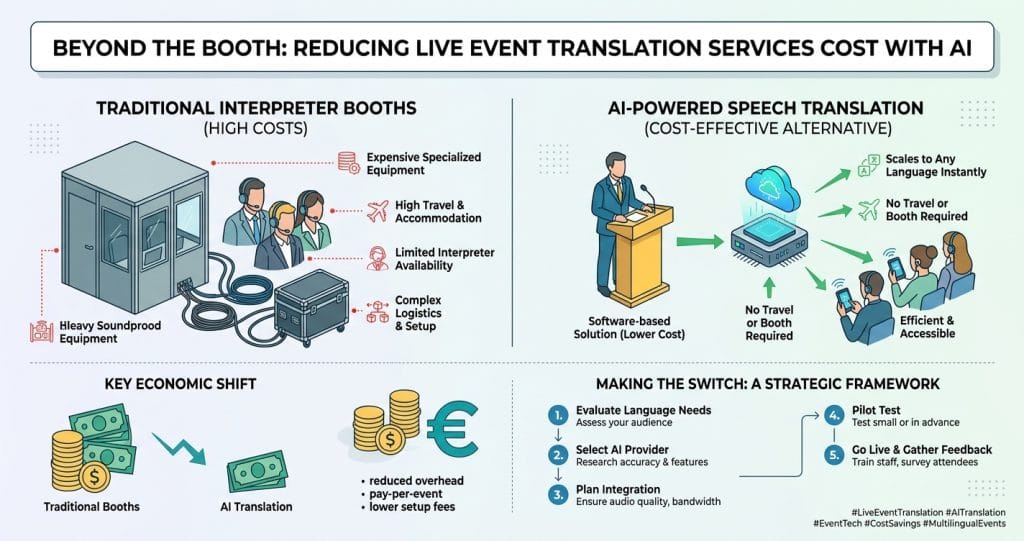
The traditional approach to multilingual events is built on a rigid, high-friction framework. Industry standards typically require booking professional interpreter pairs for every language, a necessity driven by the intense cognitive fatigue associated with simultaneous translation. Because these professionals must rotate every 20 to 30 minutes to maintain accuracy, organisers are often forced into half-day or full-day minimums, regardless of the actual event duration. This creates a significant financial burden where you pay for idle time and redundant staffing.
Beyond the hourly rates, the logistical overhead is substantial. You are not just paying for the linguists; you are accounting for lead times that span days or weeks, travel expenses, accommodation, and the rental of specialized hardware like soundproof booths and infrared headsets. This complexity makes last-minute changes or spontaneous multilingual sessions nearly impossible to execute.
In contrast, live event translation software shifts the financial model to a pay-per-minute structure. This eliminates the costs associated with idle time, travel, and physical infrastructure. The following table highlights the core differences in how these models scale:
| Feature | Traditional Interpreting | Translation Software |
|---|---|---|
| Billing Model | Half/Full-day minimums | Per-minute of audio |
| Staffing | Pairs per language | Automated AI engine |
| Lead Time | Days to weeks | Instant |
| Hardware | Booths and headsets | Browser and microphone |
By moving to a software-based model, you remove the barriers to entry. You can scale to any audience size instantly without the need to source additional equipment or personnel, ensuring that your budget is spent only on the actual time your event is live.
See it in action Book a personalised demo and we will walk you through exactly how this works for your team. Book a demo.
Deploying Live Event Translation Software for Maximum Efficiency
| Operational Area | Traditional Setup | Software Deployment |
|---|---|---|
| Setup Time | Days or weeks | Seconds |
| Hardware | Booths and headsets | Browser and microphone |
| Output Capacity | One language per pair | Five simultaneous languages |
| Data Security | Manual/Physical | Client-side encryption |