
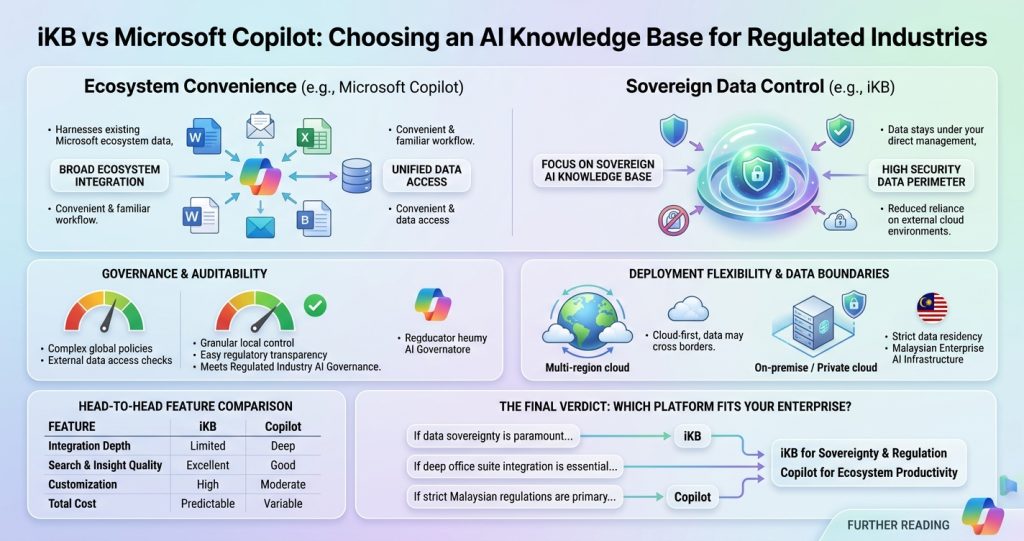
Enterprise leaders often face a tricky strategic dilemma when adopting artificial intelligence. They must choose between broad ecosystem tools like Microsoft Copilot and sovereign, governed platforms designed specifically for rigorous oversight. When deploying AI over internal policies, standard operating procedures, legislation, and private documents, organisations need to balance daily convenience with strict regulatory requirements.
This guide breaks down the differences between iKB vs Microsoft Copilot enterprise AI to help your team navigate these choices safely. We examine how each platform handles governance, data boundaries, and operational control so you can select the right fit for your regulated sector.
Understanding the Core Paradigm: Ecosystem Convenience vs. Sovereign Control
When organisations evaluate artificial intelligence for daily operations, they often look first at broad ecosystem tools like Microsoft Copilot. These productivity suites embed generative features deeply into familiar office software, making it easy for staff to draft emails, summarise notes, and build presentations within their existing digital workspace.
However, regulated industries face a much higher bar when handling internal policies, standard operating procedures, legislation, standards, manuals, and private documents. For these serious business environments, iKB provides a Malaysia-first enterprise AI governance platform built specifically for rigorous oversight. Rather than focusing purely on office convenience, the platform is designed to treat artificial intelligence as a control problem where every answer requires verifiable grounding, source citations, and risk-ready audit trails.
Ultimately, your choice comes down to a central strategic decision. If your organisation prioritises broad office integration and everyday document drafting, a standard ecosystem assistant might fit your needs. But if you operate in a knowledge-heavy or regulated sector where you must prove how conclusions are reached, maintain strict data boundaries, and satisfy local compliance requirements, choosing a sovereign governance platform ensures your business retains absolute operational control.
Governance and Auditability: Keeping Regulators Satisfied
Enterprise artificial intelligence is fundamentally a control problem rather than a simple chatbot problem. Most corporate artificial intelligence pilots fail because answers cannot be verified, data boundaries remain unclear, or business owners cannot explain how a system reached a specific conclusion. Regulated sectors need tools designed to support accountable work where every output requires proper scrutiny.
To satisfy risk and compliance teams, iKB provides robust governance structures that track prompt versions, configuration changes, moderation events, and complete answer provenance. Every generated response includes verifiable grounding, source citations, and risk-ready audit trails. For instance, risk officers can review detailed control checks, monitor attached source pages, and verify policy guards to ensure total transparency.
In contrast, standard cloud ecosystem assistants often lack the granular, sovereign oversight required by local regulators in Malaysia and the broader ASEAN region. While standard office tools focus on general productivity, iKB treats governance as a core operating requirement. By maintaining clear audit event records, traceability footers, and review trails, organisations can easily prove compliance during internal audits and external regulatory reviews.
Deployment Flexibility and Data Boundaries
When implementing enterprise artificial intelligence across regulated sectors in Malaysia and the broader ASEAN region, infrastructure adaptability matters just as much as functional capability. Standard ecosystem assistants like Microsoft Copilot typically bind organisations to strict cloud infrastructure models. While this setup offers day-one convenience, it can introduce serious compliance friction for financial institutions, government agencies, and healthcare providers that must adhere to local data residency mandates and rigorous internal sovereignty policies.
In contrast, iKB provides true deployment flexibility tailored to the complex security postures of regional enterprises. Organisations can choose from multiple operational setups depending on their specific data sensitivity requirements:
- Hosted options for rapid deployment backed by managed governance.
- Private cloud environments that keep data boundaries strictly within designated perimeters.
- On-premise setups designed for maximum internal control over sensitive document stores.
- Offline setups built specifically to handle highly confidential material without exposing data to external networks.
This wide range of deployment choices allows risk and technology teams to avoid the deployment rigidity often found in standard cloud suites. By aligning infrastructure choices directly with local regulatory frameworks across Malaysia and ASEAN, businesses can process confidential policies, standard operating procedures, legislation, and private documents with absolute confidence. Your organisation retains complete oversight of its knowledge estate, ensuring that data sovereignty never takes a backseat to convenience.
Head-to-Head Feature Comparison
When comparing enterprise artificial intelligence options, it helps to look closely at technical specifications and operational capabilities. While Microsoft Copilot offers broad integration across standard productivity suites, iKB is specifically engineered as a Malaysia-first enterprise AI governance platform that addresses storage, channels, and document handling through a sovereign lens.
| Feature Category | iKB Enterprise AI | Microsoft Copilot |
|---|---|---|
| Storage Connectors | Over 40 connectors for documents, storage, databases, websites, and APIs | Primarily tied to Microsoft 365 ecosystem and native cloud stores |
| Deployment Channels | Workspace, web chat, Slack, Teams, WhatsApp, Telegram, and API | Deep integration within Microsoft Teams and Office applications |
| Document Handling Capacity | Stress-tested up to 250,000 documents with 99 percent Malaysian-law answer rates | Optimised for general office document sizes and workspace file shares |
| Deployment Flexibility | Hosted, private cloud, on-premise, and offline setups | Standard public cloud infrastructure model |
Beyond core storage and delivery channels, sector readiness is a vital consideration for organisations operating in regulated environments. iKB is purposely designed to handle knowledge-heavy workflows across eight key sectors:
- Banking, finance and insurance: Handles policy search, compliance guidance, risk controls, claims knowledge, Shariah documentation, and audit evidence.
- Government and public services: Manages acts, circulars, standard operating procedures, citizen support, procurement rules, and policy interpretation.
- Healthcare and hospitals: Supports administrative policy, patient service knowledge, training material, and quality documentation.
- Education and universities: Powers student services, admissions knowledge, institutional policy, curriculum material, and tutor modes.
- Manufacturing and logistics: Organises safety procedures, quality manuals, maintenance documentation, and supply-chain operating knowledge.
- Legal, compliance and audit: Assists with regulatory research, contracts, standards, board papers, and evidence packs.
- Telecommunications and technology: Facilitates product documentation, incident response, support operations, and network procedures.
- Energy, utilities and infrastructure: Processes asset documents, engineering standards, operations manuals, safety cases, and contractor guidance.
By delivering verifiable grounding, source citations, and robust audit trails across these diverse industries, iKB provides the exact control mechanisms that risk and compliance teams require for safe artificial intelligence adoption.
Have questions? Get in touch with our team to talk through how this fits your business. Contact us.
The Final Verdict: Which Platform Fits Your Enterprise?
Choosing between standard ecosystem convenience and sovereign enterprise artificial intelligence depends entirely on how your organisation balances everyday office productivity with strict regulatory accountability. While Microsoft Copilot offers broad integration for general workplace files, it is primarily built as a standard public cloud assistant. For financial institutions, government agencies, healthcare providers, and other regulated entities operating in Malaysia and ASEAN, artificial intelligence adoption is fundamentally a control problem rather than a simple chatbot exercise.
When your enterprise requires verifiable grounding, strict data boundaries, and complete audit readiness over complex documentation like legislation, standards, and internal policies, iKB outperforms general ecosystem tools. It provides the exact governance mechanisms that risk and compliance teams need to ensure transparent, accountable operations across sensitive knowledge estates.
For risk officers, compliance heads, and technology leaders making their final selection, consider the following recommendations:
- Choose Microsoft Copilot if your primary goal is general office productivity, day-one convenience, and unstructured collaboration within standard cloud suites where strict local data sovereignty and deep regulatory audit trails are not core priorities.
- Choose iKB if your enterprise operates in a regulated sector, handles sensitive national or corporate data, requires absolute traceability with source citations, and demands flexible deployment options ranging from private cloud to secure on-premise and offline setups.
By placing governance, data sovereignty, and verifiable accuracy at the centre of your technology strategy, your business can embrace advanced artificial intelligence without compromising compliance or control.